Can peace and resilience lead us to joy and wonder? #oxfordchildrenswordoftheyear

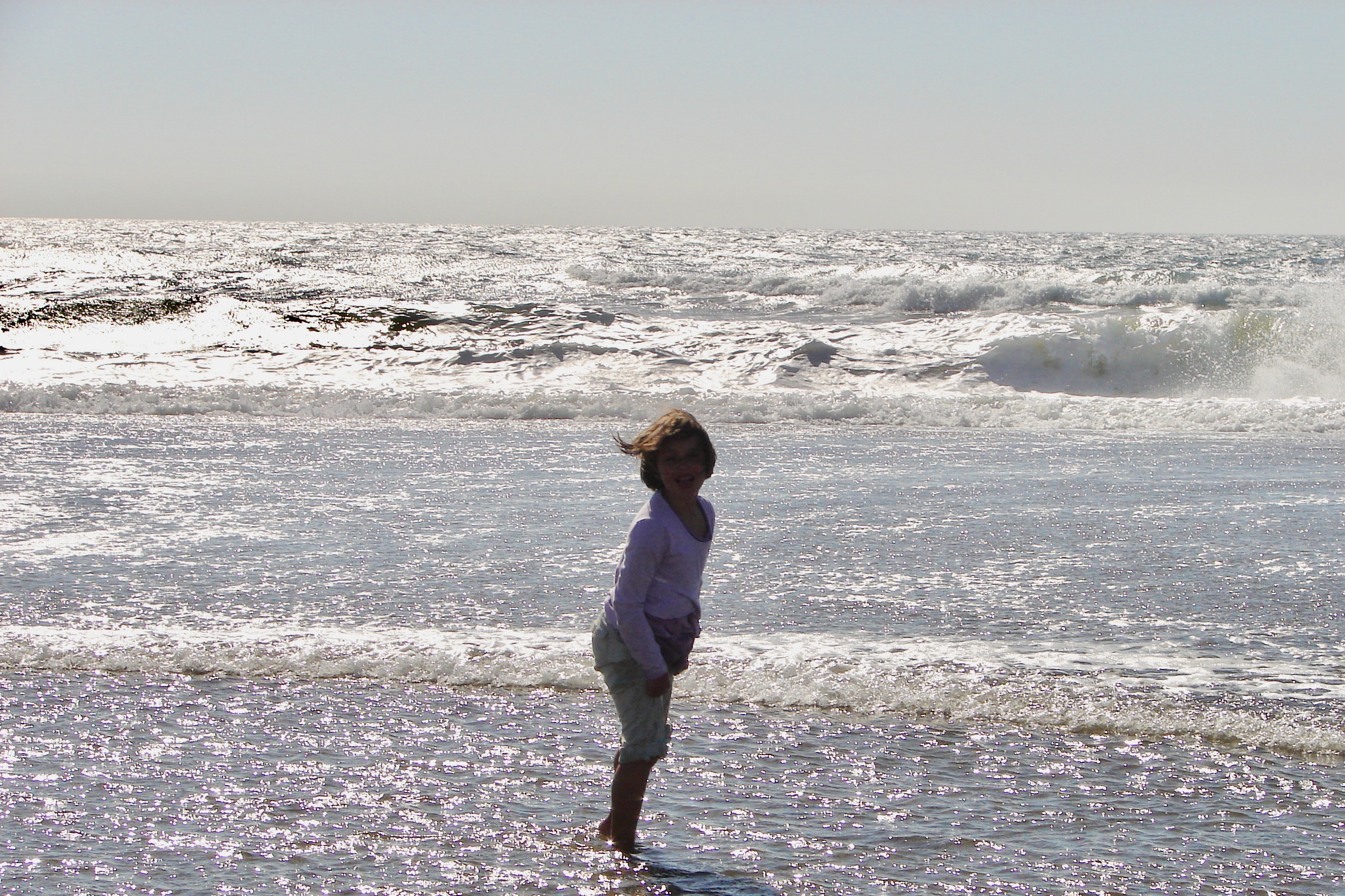
My daughter, years ago, at the Oregon coast

Perhaps you have heard the news as well. Across the U.K., a survey with youth ages 6-14 revealed “peace” to be the 2025 Oxford Children’s Word of the Year. The runner up was “AI.” Third place went to “resilience.” All three choices fitting for our global current events. There is a melancholy note of hope to the theme of the trio that speaks volumes about the world we have endowed to our children. I find myself hoping that someday the frontrunners voted by our youth will be “joy” and “wonder.” If I am being an idealist, “joy” would take first place, and “wonder” second. Perhaps “peace” would round out third, but I haven’t quite decided upon that yet. For now, I’m choosing to focus on joy and wonder.

Interestingly, one of the newsfeeds through which I heard about the Oxford Children’s Word of the Year for 2025 was 1440. At the end of their current events, they always include a quote. Today’s quote is about joy and happiness, taken from the reclusive writer J.D. Salinger. It states: “The fact is always obvious much too late, but the singular difference between happiness and joy is that happiness is a solid and joy is a liquid.”

I disagree. Rather than discuss the writer attributed to this quote, or his work, I’d like to talk about joy and wonder. Well, for sake of argument, let’s include happiness too. In fact, let’s start with it. What do you think? Is happiness, in fact, a solid form? If I were the editor and had found this statement in a work of nonfiction, my scientific and metaphysical mind would beg to disagree. I would suggest the writer forgo the term “solid,” when referring to “happiness,” and use the liquid metaphor instead. As for joy, I would endow it with light. I would give joy the properties of a photon, and add to it “wonder” as the “solid” through which it travels and emanates.

I am the idealist that Salinger appeared to eschew as Holden took center stage and Phoebe was resigned to play the role as supporting actor, but never mind that. I said I wasn’t going to make this about the author or his work. On the other hand, one cannot overlook the relevance to our present time. Here we are now, today, with our youth calling out for us to find peace in this increasingly AI generated and conflict riddled world that constantly affects our children’s internal and external state of being. And, here they are, fortified by their own youthful resilience pleading with us, more than implicitly, to find a balanced and sustainable way of existence.

This is where joy and wonder come into play as sustaining forces. For despite their dearth in our social projections, they are a constant, albeit arguably dormant state of being and driving force inside of us. When we allow ourselves to open to them, wonder becomes the vehicle through which joy rides throughout our being. It opens our cells to the spark of light that ignites us, reconnecting us to our origin story that extends and expands us beyond the confines of the corporeal, and weaves our essence into the unity of connection. When joy is ignited within us, peace becomes a constant, and resilience slips aside for there is no need for its hold. When wonder takes the reins, joy rides us into the knowing that we are, in fact, photons that seek only to dance the spectrum of light as a continuous, unbroken wave. A wave that knows no division or ending.
Community

This is the word, or concept, that keeps appearing to me when I think of the shift of human consciousness that we are experiencing. The word community has two basic meanings. It can define a group of people living in one geographic area together, or it can represent a population that shares the same values. I think the true definition melds the two.

With our myriad of technological devices and options for connecting to others that seem to negate geographical distance, no longer is there such a need to physically exist in a shared space. Space, in a sense, collapses when we open up our Facebook walls, connect to our loved ones through FaceTime, or send a text message on our cell phones. With the push of a button we are instantly brought together. Or are we?

Although I have found these methods of connection limiting, I have slowly come to embrace them. There are moments when I sit alone on the couch sending out my words, or reading the messages of others; when I feel the lonely pull to physically be with the people I am connecting with through the internet. No amount of blogging or FaceTime can replace the energy of a group of people sharing a space, especially when that space is filled with their collective joy.

So, while I cherish the ability to easily connect to friends and family who are not living nearby, as well as the opportunities I have found to form bonds with individuals I have yet to met in person, I can’t ignore the void created by distance.

I am sure I am not alone in my sentiments. What does this mean for our evolution? How will we successfully collapse time and space to share in this new era. I think some of us are discovering that it is not enough to seek community through the airwaves.

Travel has become easier and more efficient, enabling us to move to places where we can find shared values and beliefs. I have a good friend who, through circumstances beyond her control, moved and found that she and her family landed in a community that was wonderfully suited for them. So much so that it seemed predestined.

I, myself, often feel the overwhelming tug to hurry time and finish the space I am building inside my home, which will allow me to more easily host gatherings of people who seek a community of shared truths. We are not, after all, a solitary species. Humans, by nature, thrive and multiply through shared love.

Yet, I think, sometimes we forget this. Just as a child will suffer the physical and emotional symptoms of neglect in an orphanage, so does the individual who shuts herself off from interacting with others, or chooses to interact with people out of shared pain rather than love.

When we seek community, or choose not to, it behooves us to examine why. Jealousy and a strong competitive drive can cause us to be drawn to others who appear to have less, or in some way make us feel superior, therefore feeding our fears of not being good enough. Sometimes we are so consumed with our own toxic love affair with pain that we can’t help but shut others out.

If you don’t know if you are attracting the right community, ask yourself these simple questions: Do my “friends” or family bring me happiness? Do they lift me to joy? There is, after all, nothing that matches the collective vibration of love.

The Gift of Wait

in wait
In Silence Find Your Truth

I find myself inside wait, yet I am not unhappy. Between the sprints of life there is that chance to breath before we run through the next event. During the periods of waiting, we can open ourselves to receive the gifts of silence.  If we go deep enough into that silence, reaching what Deepak Chopra calls “TheGap,” we find our answers. We find peace. We find love.

When the Universe gifts us with these moments of pause, it is not perhaps our duty, as much as our best-interest to receive. Instead of looking for something to fill the empty space, we can step inside of it. Alone, inside that stillness, we find connection.

Close your eyes (or leave them open, unfocused), quiet your body and empty your mind. Let your breath lead you to that place of solitude and open the door. When you reach “The Gap,”  you will discover that, in reality, you are not alone. Your cells hum with the song of the universe; you are not wholly of yourself, but a part of everything. This is your oppertunity to reprogram and realign with your truths.

Inside silence we hear the answers to our questions, for there is nothing to muffle the voice of our higher selves. In wait, find what you seek.

“When you feel a peaceful joy, that’s when you are near truth.” 
–Rumi