Keats, Truth & Bubbles #keats #truth #odeonagrecianurn

Golden sunset
Divine Alchemy: The sky kisses water with light

This morning, while taking a much needed detox bath, I found myself watching the bubbles at my feet crack into air like cells releasing fear. How this brought my mind to Keats, I cannot honestly tell you, but that is where it decided to go. My daughter tells me she gets her greatest ideas while she showers and bathes. I tell her that’s because water is the keeper of memories and opens our awareness to what is stored inside.

Perhaps this is why the water surrounding my body opened my mind to Keats and his poem, “Ode on Grecian Urn.” I still have my copy from college, penciled with my notes. For a while, as I bathed, I thought about my obsession with the romantic poet, and how I had written my honor’s thesis about his love letters to Fanny Brawne. A few days ago I came across the thesis while going through old things.

honor's thesis on John Keats and Fanny Brawne
My honor’s thesis on John Keats

While I soaked in the tub, feeling the tension held inside my muscles give way to the warm water, my mind explored the young poet’s deeper search for love and truth. I thought about how many of Keats’ poems play with ideas greater than the death of the body he knew would lead to his early demise. The last lines of his famous poem, and the words he held within quotes, “‘Beauty is truth, truth is beauty,’ — that is all/ Ye know on earth, and all ye need to know” played out of the cells of my memory.

Annotated copy of Ode on a Grecian Urn
My annotated copy of “Ode On A Grecian Urn” by John Keats from his Selected Poems, Gramercy Books, New York

My college hand wrote the words, “truths are individual & not set & unchanging. What is beautiful to an individual is truth for that individual.”  Considered to be one one of the most quoted lines of poetry, there is also much debate over what Keats meant by this statement about beauty and truth. My own interpretation, written many years ago, addresses the subjective nature of beauty and truth, but fails to delve into the deeper Truth of what the dying poet seemed to be striving for. Whether he knew this or not is also probably up for debate.

Yet there are clues in his earlier lines implying he must have. Keats begins his famous poem with, “Thou still unravish’d bride of quietness,” then follows it with, “Thou foster-child of silence and slow time.” The poet appears to be yearning for a state that goes beyond the mortal mind. A state of eternal truth that can be reached through “silence” and “slow time,” (or no-time). While Keats may have been referring to the immortality of death, he might also have been searching for it through life.

Is this not the truth he speaks of in the last lines? A greater truth that surpasses the subjective and goes straight to the inherent beauty of Life, which I have capitalized because it extends beyond the death of the body? A state of knowing and awareness that can be reached when the chattering of the mind releases to stillness and the silent melody of the universe is heard in the soul? “Heard melodies are sweet,” Keats writes, “but those unheard/ Are sweeter.” “Pipe to the spirit ditties of no tone,” he urges before he begins to lament the impermanence of life in all its earthly forms.
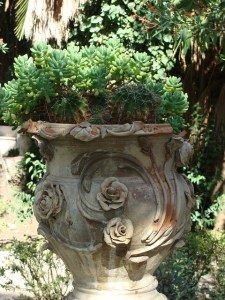
An Italian urn with succulents
An urn filled with life. Image source: Pixabay

Is an urn not also a chalice of life, as well as a container of death? The very shape speaks of the womb. I’d like to think this is what Keats was trying to show us through his ode. That beneath the impermanence and subjectivity of truth and beauty, there always exists a greater, unchangeable Truth, which is inherently beautiful. I believe he, like many do, glimpsed it on the eve of his death. Yet, we need not be on the brink of death to reach this state, we need only to free the bound mind and listen to the Truth of the “unheard melodies” that sing through the heart. Then, perhaps, the impermanence of life will be easier for us to accept, as well as the subjective nature of truth.
The Roots of the Circle

My mind is still ruminating on the circle. Last night I dreamt of water surrounding me on all sides, getting ever closer to my body. I fled before I could be stranded, not wanting to become an island, cut off, with a relentless tide washing over me.

Later, in my dreams, I found myself in a classroom as a student with my husband. The teacher was giving us assignments, and my husband and I were to write an essay about the root chakra. He told me he wanted to write about a place he calls “Blueberry Mountain,” and I found myself wondering how this related to the first chakra, where we hold our sense of stability and our fears of instability. Yet I relented, agreeing to partner with him on our shared task. While we were writing, there were interruptions. A girl I’ll call Margot, because that’s the name I gave her in my memoir, who was also in the class with us, teased and taunted, trying to disrupt the flow of our work. Trying to cut us off from our collaboration.

When I return to the circle, I think about the space in the center that is shared by all who form the perimeter. I think of the energy mingled into one collective body that is the source of all life. And, I think of an invisible network of roots feeding and nursing life.

A tree, upended, will eventually starve and wither away.

Why did my dream mind lead me to the classroom with my husband and Margot, I wondered when I woke, until I began to think about the upending of my own roots.

I met my husband when I was seventeen. In the years preceding our relationship, I had experienced multiple compromises to my family and social networks. My structure of tribal unity, held within my root chakra, was severely compromised by the time I met my future husband. It had left me feeling compromised, fearful and distrustful. Then, one day, I sat in the library of St. Paul’s School in Concord, NH, and found myself falling in love with a boy from Manchester who was writing an essay about a place he called “Blueberry Mountain.” Maybe you can go there with me someday, he told me.

The individual who finds him or herself cut off from the circle, whether willingly or unwillingly, can always return to a place of unity.

Just over 26 years ago, while siting in the library with a boy I barely knew, I began to reclaim and regrow my network of roots. I began to realize that I was not, in fact, an island of one struggling to survive amid stormy seas. I began to trust in love again.

In the center of the circle, which is also the self, there is Love.

For the past month I have been feeling naked and vulnerable. The birth of my memoir, A Girl Named Truth, has called into question my very stability. When I find myself succumbing to old patterns of thought, fear slips in and threatens to topple my roots. I temporality forget that I am not an island, even though I feel, in many ways, raw and alone. This, though, is a temporary feeling, a cruel game of the ego’s mind. When I settle my thoughts into peace, I feel the presence of all life. I feel the Light at the core, and I remember that I am never alone. That at any moment I can rejoin the circle of invisible hands and feel whole again.

Beneath the veil of fear, the body is always searching for the breath of love. When the veil is removed, nothing else exists. Without fear, the roots reach and mingle into unity and the body bends toward light.

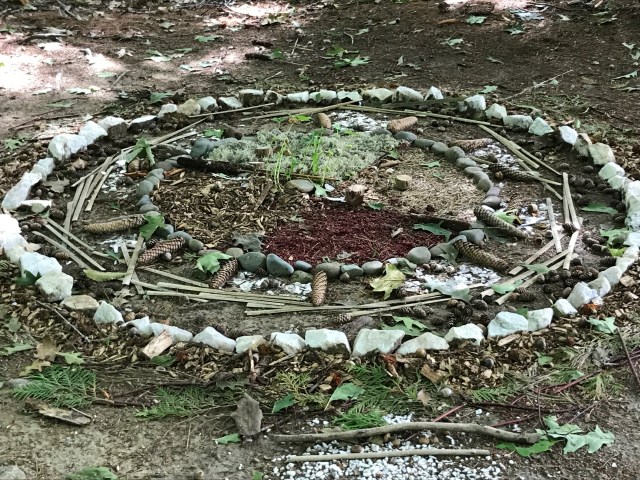
A wheel of life found in the woods
A Medicine Wheel in the forest near Mt. Kearsarge Indian Museum with legumes in the center bending and growing toward filtered light.

A Circle of Hands #unity-consciousness #empathy

I have been thinking about harmony and unity. About how, over the course of hundreds, if not thousands of years, we have moved away from the circle to form the line.

I have been thinking about the quest of the individual striving for purpose by trying to get to the head of the line, not realizing the line is an illusion.

I have been thinking about how we are birthed into human form to explore this illusion, but not to hold onto it. For there is nothing to hold onto. No hands to join your palms.

Last Friday, in my continued quest to learn the mysteries of the land near where I live, I visited the Mt. Kearsarge Indian Museum with a friend of mine. The museum, founded by Bud and Nancy Thompson, several years after Nancy taught my third grade class at Canterbury Elementary School, is deliberately arranged in the form of a circle. When you walk the rooms of artifacts recovered across the United States, your eyes pick up patterns. Themes are shared throughout the native cultures that join the people in sacred truth. The circle is one of them.

There is, by its inherent nature, no beginning or end to the circle. The line, when drawn in this form curves back to itself, and in doing so becomes part of a greater whole that never ends. Here separation is impossible. If there is a break in the circle, it ceases to be whole.

Native American Basket Art
A Continuous Circle of Hands

In my quest to find sacred sites in New England, I have been searching for circles of stone, but on Friday I found circles in other forms. Bodies, male and female, joined into circles of hands on baskets, pottery and clothing. The symbol of unity stretches across our globe.

In our more modern quest for dominance over each other, we have forgotten what it feels like to hold each others’ hands. We have forgotten that we are birthed into individuality only to discover we cannot truly make it alone. When you gaze at a circle of hands like the one show in the image above, it becomes almost an absurd hope to strive for separation.

Imagine the energy of holding an endless circle of hands. Fear has no hope here. Loneliness does not exist. The pain of the individual dissolves into the embrace of the whole. Imagine the love.

A long ago time, this was simply Life. The Circle of Live. There is a reason thousands of years ago humankind formed circles with stones to worship Life. There is a reason why bodies of hands continuously joined, and voices sang in a circle of harmony around fires.

If you doubt the power of the circle, close your eyes with me and imagine a hug of one thousand hands.

The land still remembers its hold. Can we?

Ancient Stone Circle in Scotland
A Circle of Hands in Stone, Scotland. Photo Credit: Sue Vincent

I Am

Garden Rose
A Flower of Life

 I am a collector of trash on the roadside

A mother with a gypsy soul

I am a child dancing under a filtered sky

A body waiting to ignite a billion stars

I am a river washing the sand clean

The beginning of tomorrow

And the end of yesterday

I am grace in the center

Naked

I am you

And also me


Friends Don’t Give Friends 3 Star or Below Reviews

Flower card by Quilling Card LLC
A Congratulatory Card from a Friend

I was going to incorporate this concept into another blog post I am working on about self-publishing, but I feel it is important enough to warrant its own page. It happened to me and has probably happened to other writers, especially, I suspect, those who have self-published. The receiving of the dreaded 3 star or below rating on a review site by a friend, acquaintance or an anonymous reviewer. Here is my personal opinion on this: Just like friends don’t let friends drink & drive, friends don’t give friends 3 star or below reviews. I believe that goes for fellow writers, and really anyone who chooses to publicly display a review (unless that is your profession). Here is why:

Please understand that the writer whose book you have chosen to publicly rate has just laid his or her soul on the page. It is a vulnerable and courageous act. If you cannot honor the writing by the author by a 4 or 5 star rating, it is a much kinder practice not to rate at all. Most writers and avid readers recognize that a 3 star or below review will not help an author gain more readers, it will do just the opposite. If that is your intention, than you may want to question your motives. If you feel the book is honestly offensive to potential readers, than by all means, write your review. In this instance you would be doing a service of greater good. If not, consider either not posting a review at all, and/or approaching the writer directly about why you could not a post a more favorable one. You may actually be able to help the writer craft a more polished story. When I received my 3 star review by a friend of mine, I was crushed. I still am. I would have much preferred her to contact me directly, or not rate at all. I tend to believe everything happens for a reason, though, so I wrote this post to help enlighten others. I also went back through my book, since it was self-published, and caught more of the typos, formatting, and other errors I had previously missed. There are likely more (I am only human), but it did inspire me to go through it one more time, and a cleaner copy will soon be available.

Back to the bigger picture, though. The bottom line is self-published, and writers who have published under small presses, are especially vulnerable to less-than-favorable reviews. They do not often have the resources or the privilege of having multiple editors, agents and reviewers helping them polish their craft. Instead, they are doing their best to follow their passion through into publication in the hope that other readers may find a value to their words. If you personally cannot find value in their work, that is okay. Few writers hold the misconnection that their work will be adored, or will be relatable to all readers. If you are one of them, especially if you are a friend or acquaintance, simply move on to another book.  Not rating a book at all almost makes a statement.


We are the Doorway – Tending the Light

A wonderful post Mommy Mystic on tending the light within. Please click the link below:

Source: We are the Doorway – Tending the Light

Sally’a Cafe and Bookstore – New on the Shelves – A Girl Named Truth by Alethea Kehas

My new book is featured on Sally’a Cafe and Bookstore. Check it out!

Source: Sally’a Cafe and Bookstore – New on the Shelves – A Girl Named Truth by Alethea Kehas

What we choose to remember

Forest Light
Light & Shadow

Repressed memory is a pretty common term. Most people are familiar with it, and many have probably explored their own minds in a search for what has been forgotten. When I was writing my memoir, A Girl Named TruthI spent a lot of time retrieving memories, from myself and others, and often found myself frustrated with what could not be remembered. I was obsessed with the missing gaps, not only because I wanted to fill them in with the lost scenes, I also learned a lot about what I, and others, had chosen to forget.

For example, I have no memories of going to the bathroom at night in the outhouse my family had for many years. Not one. Yet I must have. Instead, I remember the bathroom that came before the outhouse, a hole in the ground, as well as my fear of falling inside of it.

I remember being irrationally afraid of the dark and a reoccurring nightmare I had as a young child. In the nightmare, I am riding in an old brown Ford truck. My father is driving and my sister and I are crouched on the floor in terror. We are in the middle of a forest of pine trees, and swinging from their branches is a monster the size of a great ape. I always woke at the same moment, with a scream trapped in my throat, right before the monster reached the door to take me and my sister.

I don’t remember ever living with my father as a family of four. I don’t even remember visiting him before we left Oregon when I was nearly five-years-old, but when I was two-years-old, he had a fight with my mother and that became my first stored memory.

This memory is so vivid, I can tell you where I was sitting and who as on the couch beside me. I can describe for you the picture above my head. Yet, I cannot tell you what it was like to live with my father, even for half a day. And, I have a theory as to why.

In this first stored memory, I made the conscious choice, even at the young age of two-years-old, to give my father the role of villain in my story of life. My mother, in turn, I chose to love with a fierce loyalty above anyone else.

Shortly after my first memory was stored inside my mind and body, my mother ran away with me and my sister and went into hiding with the Hare Krishnas for a period of several months. Here is what I chose to remember from this long journey. The roll of green grass into blue pools of water, as well as scattered images of beautiful gods. Most of this time period has been recovered through other people’s narratives, which can be read in my memoir.

This past summer, I did some work of a regressionist/psychic friend of mine, and together we recovered some of the memories I had chosen to forget. The story, The Moon Child  came out of this remembering, but there is a more traumatic narrative I have decided not to share. What is important to the larger narrative of my life, though, is what I chose to remember as a child, what what I chose to forget, and why.  If I had decided to remember those long months in hiding, and the trauma I had endured, I would have had, I now realize, nothing to hold onto. My very foundation would have crumbled beneath me. So I made a choice for survival, as many do when they are faced with trauma, whether it be emotional, physical or both. I chose what I needed to remember and what I needed to forget.

What we choose to forget, though, lingers as truth in the recess of your body. It causes unexplainable ailments and diseases/dis-eases, until we are ready to remember. Then, if we truly want to heal and feel a greater sense of wholeness, we must ask not only what have I chosen to forget, but why have I chose to remember everything else? When we do this, our story becomes more complete. We learn why and how we have shaped our individuals lives. We may even discover that what once defined us, has changed dramatically.


Alethea is a writer and owner of Inner Truth Healing. Her memoir, A Girl Named Truth, is now available at Amazon and Amazon.co.uk. To learn more about Alethea, please visit her website, aletheakehas.com AGNT_CoverThumb

Guest author: Alethea Kehas – The Hair Puller

My contribution to Sue Vincent’s request for paranormal stories can be found here. Makes me miss my Goddard Ghost-busting days…

Source: Guest author: Alethea Kehas – The Hair Puller