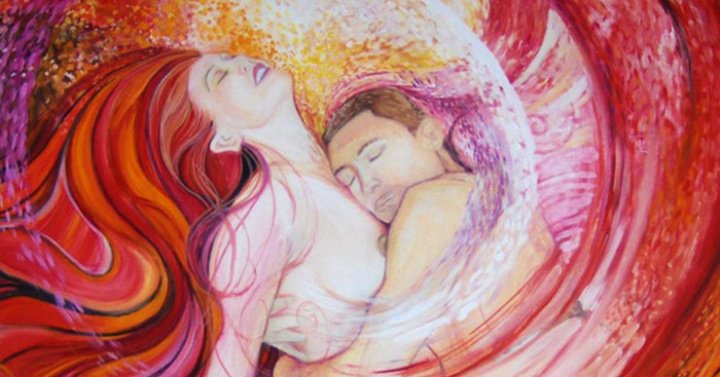
To understand the vagina properly is to realise that it is not only coextensive with the female brain, but is also, essentially, part of the female soul.
“The more closely we analyse what we consider ‘sexy,’” philosopher Alain de Botton argued in his meditation on sex, ‘the more clearly we will understand that eroticism is the feeling of excitement we experience at finding another human being who shares our values and our sense of the meaning of existence.’ But in his attempt to counter the reductionism that frames human sexuality as a mere physiological phenomenon driven solely by our evolutionary biology, de Botton overcompensates by reducing in the opposite direction, negating the complex interplay of brain and biology, psychology and physiology, that propels the human sexual experience. That’s precisely what Naomi Wolf, author of the 1991 cultural classic The Beauty Myth, examines…
Everything in life is in constant movement and change. Nothing ever stops. The only constant is change itself.
Through our life, we experience change in many forms, from key development milestones, as we witness our bodies growing and ageing, to life-changing shifts such as having children or losing loved ones. In between is a myriad of other episodic life moments, where we experience the effect of change cast over a backdrop of a moving culture, a fluctuating economy and a constantly shifting environmental landscape.
Change can be hard to deal with, especially when it is dropped down on you in the most unexpected and abrupt ways. You can suddenly lose balance, disconnect from your inner resources and feel unable to respond adequately to changing circumstances. In short, you enter into a crisis.
Traditionally, ancient castles were build where there was trouble… Do we have the equivalent in our minds and emotions? Have we, over the course of our lives, built up strong fortifications with which to repel those intrusions which, as children, we considered frightening?
The foundations for such things can begin very early, and be formed of some very primitive fears and, even, strong dislikes. That dark green colour of the man in the long raincoat who collected money and caused mother great distress. The child would see the pain of a caring parent whose finances were stretched to the limit; the deeper truth that it was a door-to-door insurance man, making his Friday call in time to tap into the new pay packet would not be seen until later in life… but the coloured raincoat would be remembered…
“… so fear was originally there to help us survive.”
“Yep… and with not many sabre-tooth tigers roaming the suburbs, we found other things to fear. And fear is intimately linked to how we judge people.”
“How so?”
It was one of those early morning conversations over coffee and from the nature of fear we had progressed to how we unconsciously judge the people that we meet. It is all very well to say that we should not judge…but we do. At least to a certain degree. Sitting in moral judgement upon someone’s actions is a slightly different matter, but we do seem to be programmed to make judgements about the people who arrive in our lives. It comes from the same primitive survival instinct as fear and is part of the same process. If a hunter comes face to face with another spear-wielding man, that snap judgement would be…
“No…! Really? That’s terrible…” It may well have been, but I doubt the subject of their gossip would have appreciated the evident relish with which the two women were discussing her misfortunes. I wasn’t eavesdropping, the strident voices were inescapable in the waiting room.
“Must be karma…” She folded her hands on her bag and sat back, nodding sagely.
“Yeah,” the lady almost licked her lips, “She must have done something really awful in a past life to deserve all that…” Here we go again, I thought, itching, as always, to jump into the conversation on that one subject, at least. Then, I suppose they would say the same of me…
It is no secret that I have fulfilled the criteria of the infamous ‘Chinese curse’ and lived in ‘interesting times’. What with one thing and another, life has never had chance to become monotonous, though…
It’s a phrase that is used very casually, as though it carries an identical meaning to us all. It’s particularly important if you want to pursue a path of mystical self-development, since the whole idea of ‘will’ is a central concept of work on the self.
What is will? We take its very existence for granted, but we should be clear in our own minds as to what we mean by it. We could say that will prevails. It is a kind of force that determines what happens next – as much as that is under our control. We will return to this subtlety of this point at the end of this short post.
It would be useless, as King Canute is reputed to have done, to exercise our will to hold back the incoming tide. Actually, Canute was a wise ruler…






 Would you like to write a guest post and be featured on this blog?
 The Light Behind the Story